Family Dentist · November 4, 2026
Your Dental Checkup After 40 and What Starts Changing
What changes at a dental checkup after 40? Learn what we watch for with gums, older dental work, dry mouth, grinding and bone health.
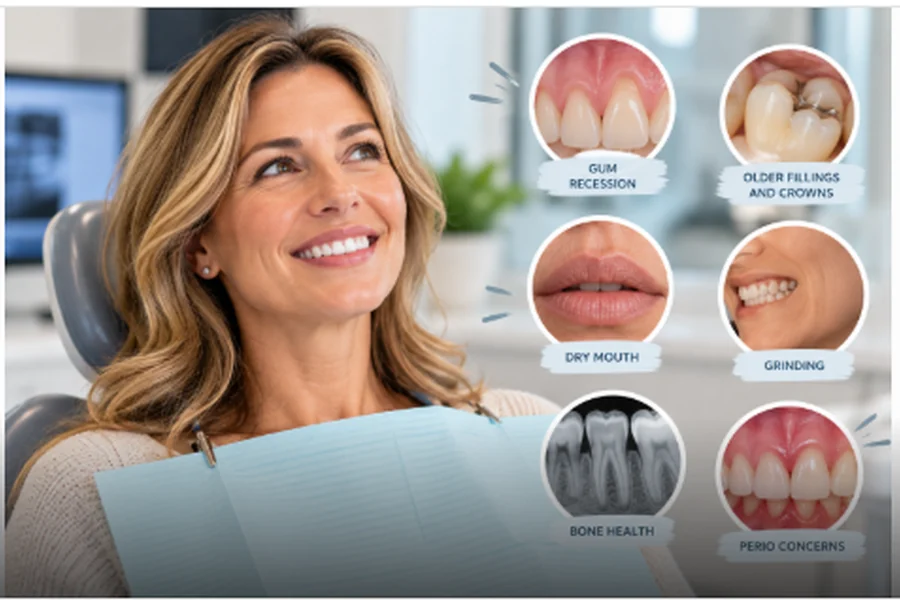
You may not think much about your age when you sit in the dental chair, but once you reach your 40s, there are a few things we start watching more closely. That doesn't mean your teeth suddenly start falling apart. Plenty of people keep healthy teeth and gums well into their 60s and beyond. Your mouth changes over time like the rest of your body, and a dental checkup after 40 is where we catch those changes early.
Your Gums and the Bone Underneath
Have you ever looked at a tooth and thought it suddenly looked longer? That is often gum recession, where the gum tissue pulls back and exposes more of the tooth or its root. It can come from gum disease, brushing too hard, tooth position or simply years of normal wear. Exposed roots tend to be more sensitive to cold, and because they don't have the same enamel protection as the rest of the tooth, we watch them for decay too.
Periodontal disease affects the gums and bone that hold your teeth in place, and it can progress without much pain. That's why we check for bleeding, inflammation, pocket depths and changes in bone levels. If we see signs of trouble, our gum disease treatment is based on what's actually happening in your mouth. The National Institute of Dental and Craniofacial Research has a helpful overview if you want to read more.
Bone health elsewhere in your body matters here as well. If you've been diagnosed with osteoporosis or osteopenia, or you take medication related to bone health, make sure your dentist knows. The Bone Health and Osteoporosis Foundation is a good place to learn about the condition itself, and we're happy to talk about how it relates to your teeth.
Older Fillings and Crowns Need a Closer Look
That crown you had done 15 years ago may still be doing its job perfectly. Dental work doesn't need to be replaced just because it's old, but it does need to be checked. Fillings can wear, crack or develop problems around their edges, and the tooth under a crown can still get decay. During a dental checkup after 40, these are the things we look at closely.
- Older fillings and crowns
- Cracks or signs of wear
- Changes around the edges of restorations
- Decay around or underneath existing dental work
- Changes in your bite
Sometimes everything looks great and we simply keep watching it. If something has changed, finding it early usually gives you more options, and we'll explain what we see before anything is scheduled. Regular dental cleanings and exams are how most of these changes get caught while they're still small.
Dry Mouth Becomes More Common
Saliva does more than keep your mouth comfortable. It washes away food and helps your teeth recover from the acids that bacteria produce. When you don't make enough of it, your risk for cavities and other problems goes up.
Many medications can cause dry mouth, and it's common to take more of them as we get older. You might notice your mouth feels sticky, you're always reaching for water or you wake up very dry in the morning. The NIDCR's page on dry mouth explains some of the common causes. Don't assume it's something you have to live with, so tell us about it and we'll talk about ways to protect your teeth.
Years of Grinding Can Add Up
Some people know they grind or clench their teeth. Others have no idea until we point out the wear. Because it happens slowly, the changes are hard to notice when you look at your own teeth every day.
Grinding can flatten teeth and may lead to cracks, sensitivity or a sore jaw. Stress can play a role, and many people do most of their clenching while they sleep. If we see unusual wear, we'll show you what we're noticing and talk through options like a custom night guard fitted to your bite.
What Your Dental Checkup After 40 Looks Like
Being over 40 doesn't mean you should expect bad teeth. It just means there are different things worth watching than when you were 20. At Dental Hygiene Centers in Fort Myers, we're looking at your gums, bone levels, existing dental work, bite and wear patterns, not only cavities.
If it's been a while since your last visit, that's okay, and you won't get a lecture. You don't need to wait until something hurts to come in, and we see patients from Fort Myers, Cape Coral, Estero and nearby areas. Request an appointment or call (239) 286-9988. Sometimes the most useful thing we can tell you is simply, "Everything looks good. Let's keep an eye on it."
Related Care
Explore Care at Dental Hygiene Centers
Have a Question About Your Smile? Ask Us.
New patients welcome from Fort Myers, Cape Coral, Estero, Bonita Springs, and McGregor.